
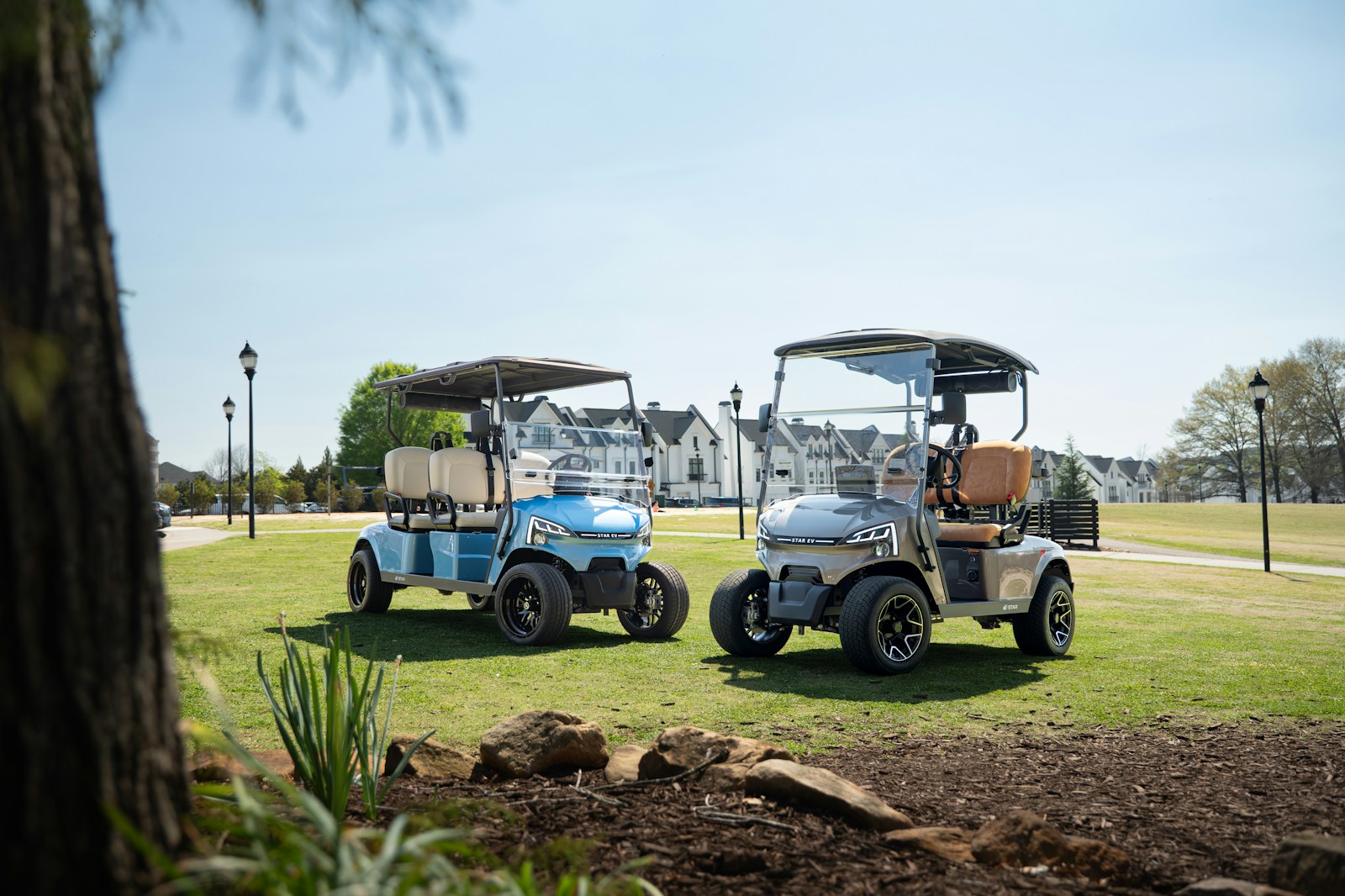
Golf carts are a legitimate transportation option in Woodstock, Cherokee County, and much of north metro Atlanta — in the right neighborhoods, on the right roads, with the right equipment. The rules that make a golf cart street-legal in Georgia are written into state law, and they are specific enough that a lot of cart owners are technically out of compliance without knowing it. This guide covers what the law actually requires, how low-speed vehicles (LSVs) differ from standard carts, what Cherokee County residents need before driving on a public street, and what to look for in a cart that is genuinely built for neighborhood use.
Georgia's Golf Cart Law: The Basics
Georgia allows golf carts on public roads under specific conditions, governed by O.C.G.A. § 40-6-331. The core rules are:
Posted speed limit of 35 mph or less. Golf carts in Georgia may only be operated on public roads with a posted speed limit of 35 mph or lower. They cannot be driven on roads posted above 35 mph, and they cannot cross roads posted above 35 mph except at a crossing specifically designated by the local governing authority.
Daylight hours only — unless equipped for nighttime operation. Georgia law permits golf cart operation between one half-hour before sunrise and one half-hour after sunset. After that, the cart must have headlights, brake lights, turn signal lights, and reflective devices that meet federal motor vehicle safety standards.
Driver licensing requirements. The operator must have a valid driver's license — with one exception: on private roads or subdivisions that have authorized golf cart operation, and where the governing authority has established local rules, the minimum age may differ. Check with your local jurisdiction (Cherokee County government or the City of Woodstock) for any local ordinances that supplement state law.
Equipment requirements. The cart must have a braking system, a steering apparatus, a windshield (or the cart must display a decal indicating compliance with applicable standards), a rearview mirror, and safety reflectors. The specifics of what constitutes compliance have evolved, so verify your equipment against the current statute before operating on public roads.
Golf Cart vs. Low-Speed Vehicle (LSV): Not the Same Thing
A golf cart and a low-speed vehicle (LSV) are frequently confused, but they are different vehicle classifications with different rules. Understanding the distinction matters before you buy.
A golf cart under Georgia law is a vehicle manufactured for use on a golf course, with a maximum speed of 20 mph. It is subject to the local-road-use rules described above and cannot legally be operated on any road with a speed limit above 35 mph.
A low-speed vehicle (LSV), also called a neighborhood electric vehicle (NEV), is a federally classified motor vehicle with a top speed between 20 and 25 mph and must meet federal safety standards including seat belts, headlights, taillights, brake lights, turn signals, a rearview mirror, and a windshield meeting federal standards. LSVs are registered with the state, carry a vehicle identification number (VIN), and can legally be driven on roads with posted limits of 35 mph or less — the same roads as golf carts, but with a federally-standardized safety equipment package and state registration.
The practical implication for buyers: if you want a cart that you can drive legally in your Cherokee County neighborhood without modifications, an LSV-classified vehicle straight off the lot is the cleaner path. Many buyers start with a standard golf cart and add aftermarket safety equipment to comply with Georgia's street-use requirements — which is permitted, but the equipment must actually meet the legal standard, not just look like it does.
What You Need Before Driving on a Woodstock Public Street
Here is a practical checklist before you take your cart out on a Cherokee County public road:
- Verify the road's posted speed limit. Only roads posted at 35 mph or below are legal for golf cart operation under state law. Many main roads in and around Woodstock are posted above that threshold.
- Check your cart's equipment. At minimum: functioning brakes, steering, rearview mirror, and safety reflectors. For nighttime operation: headlights, brake lights, and turn signals meeting federal standards.
- Have a valid driver's license. This is the default state rule. Check whether your subdivision or local municipality has adopted a local ordinance with different age or licensing rules.
- Understand your insurance exposure. A golf cart operated on a public road is not automatically covered by your standard auto insurance policy. Many homeowners' policies include limited cart coverage for private property. Contact your insurance agent before driving on a public road to confirm your coverage — or get a separate golf cart policy.
- Know the crossing rules. If your route requires crossing a road posted above 35 mph, that crossing must be designated by the governing authority as a legal crossing point. You cannot cross a 45 mph road at will because it is the fastest route.
Why Golf Carts Work Well in Cherokee County Neighborhoods
Cherokee County's mix of lower-density subdivisions, planned communities, and smaller commercial districts creates a lot of situations where a golf cart is genuinely practical. Running to a neighbor's house, getting to a community pool or clubhouse, doing a short errand in a neighborhood with a village-style commercial area — a cart handles these trips with zero fuel cost, minimal maintenance, and no parking hassle.
The Woodstock downtown area, with its walkable blocks and active restaurant and retail scene, also draws cart owners on weekends. The posted speed limits in the downtown district are compatible with golf cart operation, and the shorter, slower trip from a neighborhood half a mile away is a realistic use case for a well-equipped cart.
The key to making this practical is picking the right cart from the start — one that is already equipped for legal street use, not one that will require $500 in aftermarket lighting and hardware before it is compliant.
Choosing a Cart for Street and Neighborhood Use at Prime Golf Carts of Woodstock
At Prime Golf Carts of Woodstock, we carry eight brands — Atlas, Epic, Evolution, ICON, Tomberlin, Venom EV, Voyager EV, and Star EV — several of which offer factory-configured street-legal and LSV-classified models with the lighting, mirrors, and safety equipment already built in. Rather than buying a base cart and retrofitting it, a factory street-legal or LSV model gives you a known-compliant starting point.
When you come in, tell us you want a cart primarily for neighborhood road use. That narrows the selection to the models and configurations that actually make sense for that use case — we are not going to sell you a stripped-down course cart for a street application. If you have specific roads in mind or a subdivision with its own rules, bring that information and we can match accordingly.
We are located at 10971 Hwy 92, Unit I in Woodstock. Call us at (470) 349-0381 or visit our contact page to ask questions or schedule a visit. Current hours: Wednesday 1–6 PM, Thursday through Saturday 9–5 PM, Sunday 11 AM–4 PM.
Frequently Asked Questions
Do I need to register a golf cart with the state of Georgia?
A standard golf cart operated under the Georgia golf cart law (O.C.G.A. § 40-6-331) on local roads with posted limits of 35 mph or less does not require state registration or a license plate. A low-speed vehicle (LSV) is a different classification — it is a federally regulated motor vehicle and must be titled and registered with the Georgia Department of Revenue, Motor Vehicle Division, like any other car or truck. Ask us which category applies to the specific model you are considering.
What is the minimum age to drive a golf cart in Woodstock?
Under Georgia state law, a valid driver's license is required to operate a golf cart on a public road. Many subdivisions and private communities establish their own rules for golf cart operation within the community, which may differ from state law. Check with your HOA or local government for any applicable local ordinances.
Can I drive a golf cart on GA-92 in Woodstock?
GA-92 through most of the Woodstock area is posted above 35 mph, which makes it off-limits for golf cart operation under state law. Golf carts are limited to public roads with posted limits of 35 mph or below, and may only cross a higher-speed road at a designated crossing. Verify specific road limits before planning a route.
How far can an electric golf cart go on a charge?
Range varies significantly by model, battery type (lead-acid vs. lithium), terrain, load, and speed. Most modern electric carts with lithium batteries are rated for 30 to 50 miles per charge under typical conditions; lead-acid packs typically provide 20 to 35 miles. For neighborhood use — short trips, flat terrain, no highway speeds — range is rarely a practical constraint. We can walk you through the real-world range of any model we carry based on your specific use case.
Do you service golf carts you did not sell?
Yes. Our service team works on golf carts regardless of where they were purchased. If you have a cart that needs maintenance, battery service, or a safety equipment upgrade to meet street-use requirements, give us a call at (470) 349-0381 or reach us through our contact page.